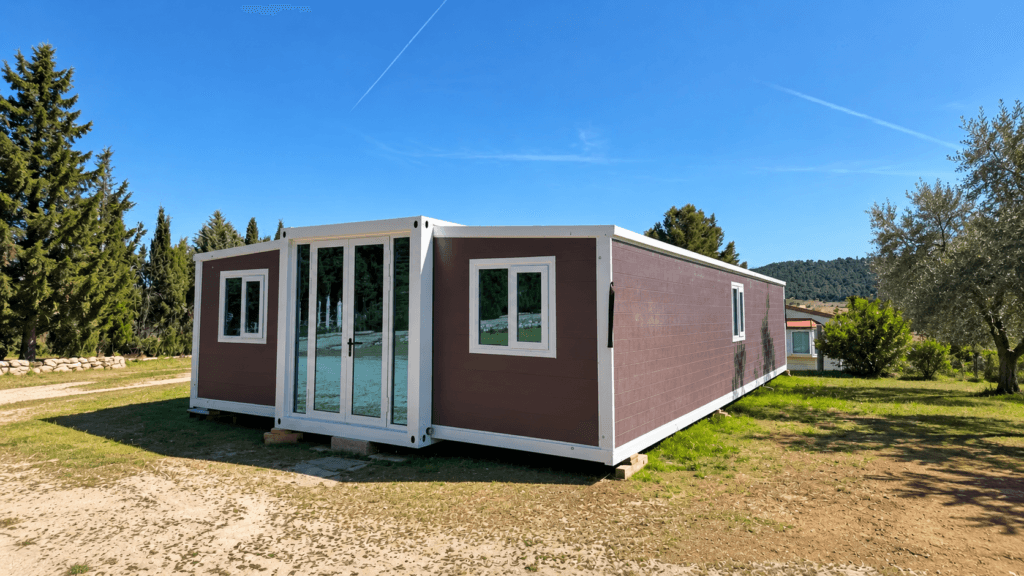
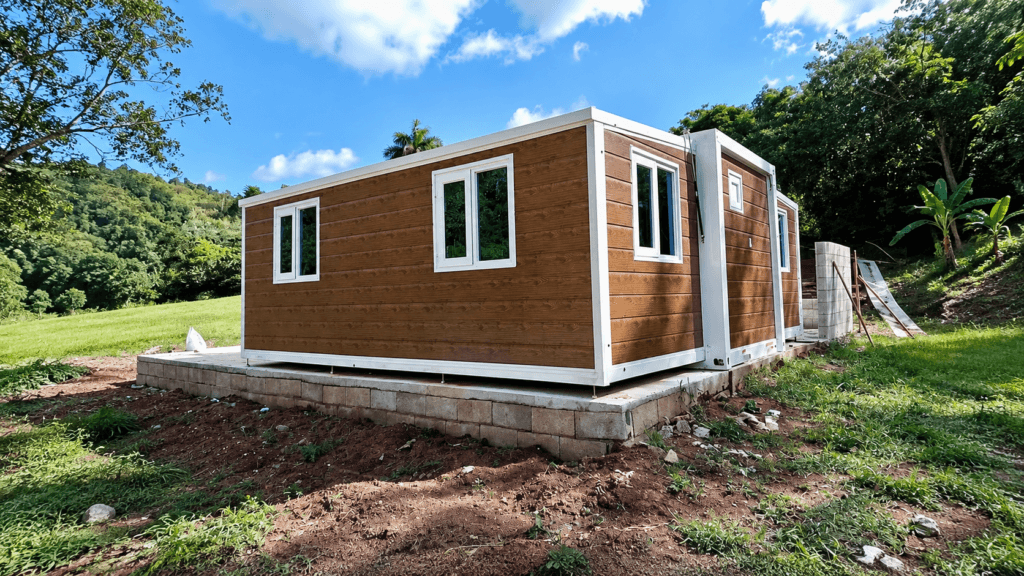
If you are considering buying an expandable container house from China, one of the first questions is usually:
How much does an expandable container house cost in 2026?
The short answer is that a standard expandable container house price can range from approximately USD 4,500 to more than USD 12,000 per unit, depending on the house size, floor plan, insulation, interior configuration, windows, exterior finish and other customization options.
However, the factory price is only one part of the total cost.
For international buyers, the final expandable container home cost normally consists of:
House price + optional upgrades + ocean freight + local transportation + import duty/tax + installation/site preparation.
In this guide, Nexspace explains the main factors affecting the expandable container house cost in 2026, including house size, specifications, customization and international shipping costs from China.
Expandable Container House Price in 2026
The most important factor affecting the expandable container house price is the size of the house.
Expandable houses are manufactured in several standard sizes, with 20FT, 30FT and 40FT expandable container houses being among the most popular models for international projects.
A general factory-price reference is:
| Expandable House Size | Approx. Living Area | Typical Factory Price |
|---|---|---|
| Compact / 10–15FT Models | Approx. 15–28 m² | USD 4,500–5,500+ |
| 20FT Expandable Container House | Approx. 37 m² | USD 6,000–7,500+ |
| 30FT Expandable Container House | Approx. 55 m² | USD 8,500–9,500+ |
| 40FT Expandable Container House | Approx. 74 m² | USD 10,500–12,000+ |
| Fully Customized / Premium Models | Varies | USD 12,000+ |
These prices are intended as a general reference rather than a fixed quotation.
The exact expandable container house cost depends on the specifications selected for each project.
Does a Larger Expandable Container House Cost More?
Yes.
A larger expandable container home naturally requires more steel, wall panels, flooring, electrical materials, windows and interior finishing materials.
Therefore, the total price generally increases as the house becomes larger.
For example, a 37 m² 20ft expandable container house costs substantially less in total than a 74 m² 40ft expandable container house.
However, the price per square meter does not necessarily increase with size.
In many cases, larger expandable houses can actually have a similar or lower average cost per square meter because several fixed manufacturing costs—including electrical systems, bathrooms, plumbing and structural components—are distributed across a larger floor area.
This is one reason why larger expandable container houses can be attractive for:
Family residences
Vacation homes
Rental properties
Airbnb projects
Worker accommodation
Resorts
Offices
Modular accommodation projects
For buyers comparing different models, it is therefore better to consider both the total expandable container house price and the usable living area rather than looking only at the purchase price.
20FT Expandable Container House Price
The 20ft expandable container house is one of the most popular models because it provides a good balance between price, transportation efficiency and living space.
After expansion, a typical 20FT model provides approximately 37 m² of interior space.
A typical factory price is approximately:
USD 6,000–7,500
depending on configuration.
Common layouts include:
1 bedroom + living room + bathroom
2 bedrooms + living room + bathroom
2 bedrooms + kitchen + bathroom
Customized studio layout
Optional terraces, additional bathrooms, upgraded kitchens, decorative exterior panels and larger glass areas can increase the final price.
For buyers searching for an affordable prefab house from China, the 20FT model is usually one of the most economical choices.
30FT Expandable Container House Price
A 30ft expandable container house normally provides approximately 55 m² of usable space.
Typical factory pricing is approximately:
USD 8,500–9,500+
This size is particularly suitable for buyers who want a more comfortable permanent or semi-permanent residence.
Typical layouts can include:
2 bedrooms
3 bedrooms
Living room
Kitchen
1–2 bathrooms
Compared with a smaller container house, the 30FT model provides significantly more flexibility when designing the floor plan.
For residential projects, rental properties and small holiday homes, this size offers a good balance between space and overall investment.
40FT Expandable Container House Price
The 40ft expandable container house is generally the largest standard model.
After expansion, some models provide approximately 70–74 m² of usable living space.
Typical factory pricing starts at approximately:
USD 10,500–12,000+
depending on specifications.
The larger interior space allows layouts such as:
3 bedrooms + living room + kitchen + bathroom
2 bedrooms + large living room
3 bedrooms + 2 bathrooms
Large open-plan living areas
Customized rental accommodation
For families, resorts and commercial accommodation projects, the 40ft expandable container house can provide considerably more living space while maintaining the installation advantages of modular construction.
What Affects Expandable Container House Prices?
House size is only the first factor.
There are several other important factors that determine the final expandable container house price.
1. Wall Insulation
Different climates require different insulation systems.
Common wall panel materials include:
EPS sandwich panels
Usually the most economical solution and suitable for many moderate-climate applications.
Rock wool sandwich panels
Provides improved fire resistance and acoustic performance.
Polyurethane / PU sandwich panels
Provides stronger thermal insulation and is often recommended for colder climates.
Increasing insulation thickness—for example from 50 mm to 75 mm or 100 mm—will also increase the manufacturing cost.
Buyers in Northern Europe, Canada, colder regions of the United States and similar climates often choose upgraded insulation.
2. Doors and Windows
Standard expandable houses usually use relatively simple doors and windows.
However, customers can upgrade to:
Double-glazed windows
Thermal-break aluminum windows
Larger windows
Sliding glass doors
Mosquito screens
Glass curtain walls
Large areas of glass can significantly change both the appearance and the price of an expandable house.
3. Kitchen and Bathroom Configuration
A basic expandable container home may include only essential plumbing and sanitary equipment.
More complete configurations can include:
Kitchen cabinets
Sink
Countertop
Bathroom vanity
Shower enclosure
Toilet
Water heater
Plumbing
Electrical system
Adding a second bathroom or a larger kitchen will naturally increase the expandable container home cost.
4. Exterior Decoration
Buyers can choose different exterior finishes depending on their target market.
Options may include:
Standard sandwich panel
Wood-grain exterior panels
Customized colors
Glass curtain walls
Decorative roofing
Terrace structures
A simple standard house will cost less than a highly customized model designed for resorts, Airbnb accommodation or premium residential projects.
5. Electrical Standards
Electrical requirements vary between countries.
Expandable houses exported to different markets may require different:
Voltages
Frequencies
Sockets
Distribution boxes
Wiring specifications
Circuit breakers
For export projects, the electrical system should normally be configured according to the destination country’s requirements.
How Much Does It Cost to Ship an Expandable Container House from China?
This is one of the most important questions for international buyers.
Nexspace’s expandable houses are generally shipped from Tianjin Port, China, one of the major international ports serving northern China.
The exact container house shipping cost depends heavily on:
Destination port
Shipping season
Container availability
Fuel prices
Port congestion
Shipping line
Route capacity
Geopolitical conditions
Peak-season demand
Therefore, international freight should never be treated as a permanent fixed price.
As of 2026, container freight rates remain relatively volatile.
The following ranges can be used for preliminary budgeting for a 40HQ container shipped from China.
China to Europe Shipping Cost
Typical markets include:
Germany, Netherlands, Belgium, France, Spain, Portugal, Italy, Hungary, Poland, Romania and other European countries.
A reasonable ocean-freight budgeting range is approximately:
USD 4,000–7,000 per 40HQ
for many European routes.
Northern European ports such as:
Rotterdam
Hamburg
Antwerp
usually have strong shipping connections with China.
Mediterranean ports such as:
Valencia
Barcelona
Genoa
Piraeus
may have different rates depending on shipping capacity.
In late August 2026, benchmark Shanghai freight rates were approximately USD 4,287 per 40FT to Rotterdam and USD 4,866 to Genoa, illustrating the level of current Asia-Europe spot freight.
For inland European destinations such as Hungary, Austria or the Czech Republic, buyers should also budget for port-to-door trucking or rail transportation after the container reaches Europe.
China to North America Shipping Cost
For the United States and Canada, there is a significant difference between West Coast and East Coast routes.
US / Canada West Coast
Ports such as:
Los Angeles
Long Beach
Vancouver
may typically require approximately:
USD 5,500–8,000 per 40HQ
depending on the market.
US / Canada East Coast
Ports such as:
New York
Savannah
Houston
Miami
usually involve longer routes and higher freight costs.
A rough budgeting range is:
USD 7,500–10,500+ per 40HQ
In late August 2026, Drewry reported approximately USD 6,818 from Shanghai to Los Angeles and USD 9,333 from Shanghai to New York for a 40FT container.
China to Latin America and the Caribbean
Markets may include:
Chile
Brazil
Mexico
Colombia
El Salvador
Panama
Trinidad and Tobago
Dominican Republic
Caribbean islands
Shipping costs vary substantially because some destinations require transshipment.
A general budgeting range is approximately:
USD 5,000–9,000+ per 40HQ
Remote islands or ports requiring multiple transshipments can be considerably more expensive.
For buyers in Latin America and the Caribbean, requesting a current freight quotation before placing an order is particularly important.
China to Australia and New Zealand
Australia and New Zealand are important markets for prefabricated houses and expandable container homes.
Typical destinations include:
Sydney
Melbourne
Brisbane
Auckland
Christchurch
A reasonable budgeting range in the current market is approximately:
USD 4,000–7,000 per 40HQ
depending on destination and shipping conditions.
The Australia route has experienced significant rate changes during 2026, and logistics providers reported additional General Rate Increases and capacity pressure heading into September.
Therefore, quotations should always be confirmed close to the actual shipping date.
China to the Middle East
Major destinations include:
UAE
Saudi Arabia
Qatar
Oman
Kuwait
Depending on destination and shipping conditions, approximate 40HQ ocean freight may be around:
USD 2,500–5,000
The Middle East is relatively well connected with major Chinese ports, although geopolitical developments and fuel costs can cause rapid freight fluctuations.
China to Africa
Common destinations include:
South Africa
Kenya
Tanzania
Ghana
Nigeria
Mauritius
Shipping distances and transshipment requirements vary considerably.
A rough budgeting range is:
USD 4,000–8,000+ per 40HQ
Island destinations and inland delivery can increase total logistics costs substantially.
Why Did Container Shipping Costs Increase in 2026?
International freight prices do not move in a straight line.
During 2026, several major shipping lanes experienced rapid weekly increases and decreases.
For example, Freightos reported that during one week in June, Asia-US West Coast rates increased 51%, Asia-Northern Europe rates increased 37%, and Asia-Mediterranean rates increased 24%.
Later in the summer, rates softened on some routes before increasing again as congestion, blank sailings and capacity management affected the market.
This is why a quotation received several months before shipping should not be considered a guaranteed shipping price.
At Nexspace, freight quotations are normally recalculated according to the destination and current shipping market before shipment.
How Many Expandable Container Houses Fit in One Shipping Container?
Transportation efficiency is one of the major advantages of an expandable container house.
The house is transported in its folded condition and expanded after arrival.
For some common models, multiple units can be loaded into a 40HQ container.
For example, depending on dimensions and specifications, a 40HQ can commonly carry approximately:
2 × 20FT expandable houses
Actual loading quantities depend on the folded dimensions, model, roof design and additional accessories.
This reduces the shipping cost per expandable house, especially for distributors or project buyers ordering multiple units.
For larger wholesale orders, optimizing container loading can significantly reduce the overall landed cost per house.
Factory Price vs Landed Cost
When comparing different expandable container house manufacturers, buyers should not compare factory prices alone.
For example:
A house may cost:
USD 6,000 at the factory
but the buyer may also need to pay:
Ocean freight
Port charges
Customs clearance
Import duty
VAT/GST
Inland transportation
Crane or unloading
Foundation preparation
Installation
The final amount after all these expenses is commonly called the landed cost.
Import taxes vary significantly by country, so buyers should consult a local customs broker before importing an expandable house.
Is an Expandable Container House Cheaper Than Traditional Construction?
In many markets, yes.
One of the main advantages of an expandable prefab house is that most of the manufacturing is completed inside the factory.
Compared with traditional construction, this can reduce:
On-site construction time
Labor requirements
Material waste
Project management complexity
Installation time
Once transported to the destination and placed on a prepared foundation, an expandable house can normally be installed much faster than a conventional masonry or concrete building.
However, local building regulations, foundation requirements and planning permission should always be checked before purchasing.
How to Get an Accurate Expandable Container House Quote
If you want an accurate expandable container house price, the best approach is to provide the manufacturer with the following information:
1. Destination country and postcode
This allows the supplier to calculate the shipping route.
2. Required house size
For example:
20FT / 37 m²
30FT / 55 m²
40FT / 74 m²
3. Required number of bedrooms and bathrooms
The floor plan directly affects production cost.
4. Climate
Cold, tropical, coastal and high-wind environments may require different insulation or structural specifications.
5. Intended use
For example:
Residential home, rental property, Airbnb, resort, office, worker accommodation or distributor inventory.
Once these requirements are known, the manufacturer can recommend the most suitable specifications and calculate a more accurate total cost.
So, How Much Does an Expandable Container House Cost in 2026?
For most projects, the expandable container house factory price in 2026 can be summarized approximately as:
USD 4,500–5,500+ for compact models
USD 5,000–7,500+ for a 20FT expandable container house
USD 7,500–9,500+ for a 30FT expandable container house
USD 9,500–12,000+ for a 40FT expandable container house
Premium customization can increase the price further.
International buyers should then add shipping, import taxes and local delivery expenses to calculate the complete landed cost.
Because both house specifications and international freight rates vary considerably, the most accurate approach is always to request a project-specific quotation.
Looking for an Expandable Container House Manufacturer in China?
Nexspace supplies expandable container houses for residential, commercial, rental and modular accommodation projects worldwide.
Our expandable houses are available in multiple sizes and can be customized with different:
Floor plans
Wall insulation systems
Exterior finishes
Windows and doors
Kitchens
Bathrooms
Electrical systems
Interior finishes
Whether you need a single expandable container home or multiple units for distribution or a commercial project, we can configure the house according to your requirements and destination market.
Contact Nexspace with your required house size, floor plan, quantity and delivery location to receive an updated expandable container house price and shipping quotation.