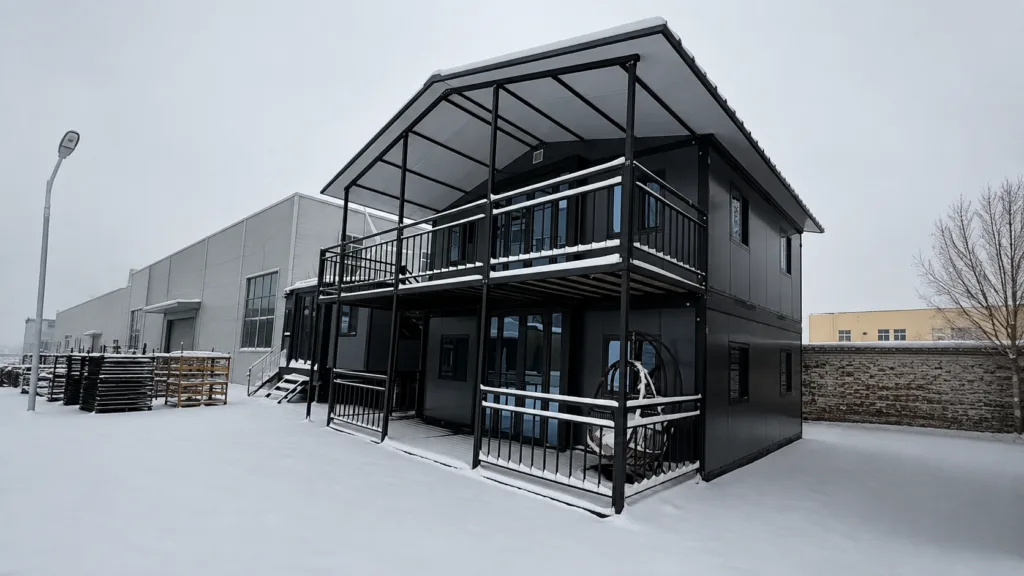
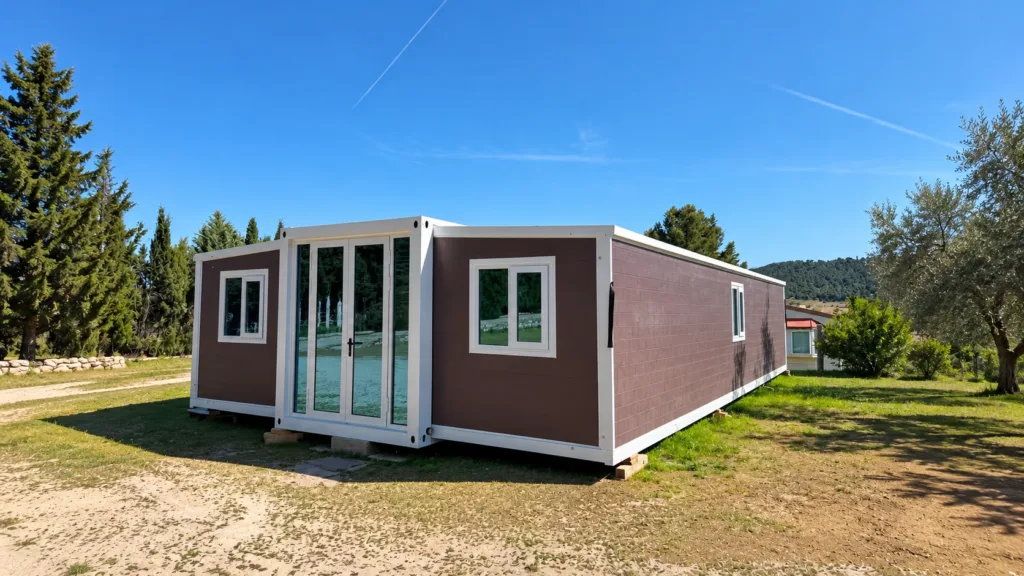
If you plan to install an expandable container house near the sea, on an island, or in a humid tropical region, corrosion resistance should be considered before production — not after rust appears.
Steel is strong, durable and ideal for modular construction, but moisture, salt and repeated wet-dry cycles can accelerate corrosion when the steel surface, joints and drainage details are not properly protected.
In coastal locations, the problem is especially obvious. Salt carried by sea air can remain on exposed metal surfaces. When combined with condensation, rain and humidity, it creates a much more aggressive environment than normal inland conditions.
For customers in coastal and humid markets, anti-corrosion performance therefore depends on much more than simply “painting the steel.”
A durable expandable container house requires protection at several levels:
steel material, surface treatment, coating, joints, drainage, wall design and regular maintenance.
Why Do Expandable Container Houses Rust Faster Near the Sea?
Corrosion occurs when steel is exposed to moisture and oxygen.
In a normal dry inland environment, this process may be relatively slow. Near the coast, however, airborne chlorides from sea salt increase the conductivity of moisture on the steel surface and accelerate the corrosion process.
ISO 12944 classifies atmospheric environments according to corrosivity. Coastal areas with moderate salinity can fall into higher corrosion categories, while areas with very high salinity or severe marine exposure require substantially stronger protective systems.
This is why two identical steel buildings can age very differently even if they are the same distance from the equator.
Actual corrosion depends on factors such as:
- distance from the sea;
- airborne salt concentration;
- rainfall;
- humidity;
- temperature;
- condensation frequency;
- whether rain can wash salt deposits away;
- and how long steel surfaces remain wet.
Data from the American Galvanizers Association also shows that even two coastal cities can have very different galvanized-steel corrosion rates because of differences in salinity and daily condensation conditions.
So when choosing an expandable container house for a coastal project, simply asking:
“Is the frame galvanized?”
is not enough.
The better question is:
How is the entire corrosion-protection system designed?
1. Start with Galvanized Steel, Not Bare Carbon Steel
For the structural frame, galvanizing is one of the most important first lines of protection.
Galvanized steel is coated with zinc. The zinc layer acts as both a physical barrier and a sacrificial protective layer for the steel underneath.
This is especially valuable on modular buildings because transport, installation and repeated handling may cause small scratches or coating damage.
If the decorative paint layer alone is damaged on ordinary untreated steel, exposed steel can begin rusting quickly.
With a properly galvanized substrate, the zinc layer provides additional protection underneath.
ISO 12944 specifically recognizes galvanized steel and other zinc-treated surfaces as substrates used in corrosion-protection systems.
For expandable container houses intended for humid or coastal areas, we therefore recommend paying particular attention to:
- main frame material;
- galvanized coating quality;
- welded areas;
- cut edges;
- corner connections;
- and areas that may be scratched during transportation.
2. The Weakest Areas Are Often Welds, Cut Edges and Drilled Holes
A steel frame may look well protected overall, but corrosion commonly starts at small local defects.
High-risk areas include:
- welding points;
- cut steel edges;
- drilled holes;
- screw connections;
- damaged paint;
- corners;
- roof-frame joints;
- and areas where panels rub against the steel frame during transportation.
Why?
Because cutting and welding can damage or remove part of the protective coating.
Once the underlying steel is exposed, moisture and salt can attack that point first.
For coastal houses, these areas should therefore receive additional attention during production.
A good anti-corrosion process should include inspection and touch-up treatment after welding, cutting and assembly — instead of assuming that the original coating remains perfect everywhere.
Surface preparation is also a critical part of any protective paint system; ISO 12944 treats surface preparation as a separate part of corrosion control rather than simply focusing on the final paint layer.
3. Paint Is Important — But Paint Alone Is Not Enough
Some customers judge corrosion resistance by looking at how thick or attractive the exterior paint appears.
That can be misleading.
A painted surface can look excellent when the house leaves the factory, but long-term corrosion resistance depends on the complete coating system underneath.
For higher-corrosion environments, a better approach is a multi-layer protection concept:
steel substrate → galvanized protection → suitable primer/coating → exterior finish
Protective paint systems are selected differently depending on environmental exposure and expected durability. ISO 12944 provides guidance for choosing coating systems according to corrosivity class rather than using one universal paint system everywhere.
For projects close to the sea, ordinary interior-grade coatings should not simply be assumed to perform the same way as coatings designed for aggressive outdoor exposure.
The project location should be considered before production.
4. Good Drainage Can Be Just as Important as Better Paint
One of the most overlooked causes of corrosion is standing water.
Even a good protective coating will age faster if water continually collects around:
- roof joints;
- steel channels;
- bottom frames;
- screws;
- corners;
- gutters;
- or connection gaps.
Corrosion-protection guidance for steel structures specifically emphasizes avoiding moisture traps, dirt traps and poorly drained details.
Good detailing should help water leave the structure quickly and reduce the amount of time the steel remains wet.
This is particularly important for expandable houses because they contain many moving and connecting components.
A coastal version should therefore pay attention not only to material specifications, but also to:
- roof slope;
- gutter design;
- drainage channels;
- sealing around joints;
- bottom-frame drainage;
- and avoidance of areas where rainwater can remain trapped.
In other words:
Anti-rust design starts with controlling water.
5. Roof Water Should Be Directed Away from the Walls and Base
Poor rainwater management often creates the visible “yellow rust water” that customers complain about.
Water may repeatedly pass across a slightly corroded steel joint, pick up rust particles, and then leave brown or yellow streaks on:
- exterior wall panels;
- corners;
- doors;
- windows;
- and the lower steel frame.
Even if the structural damage is still minor, these stains make a relatively new house look old.
That is why roof drainage matters.
A properly designed roof and gutter system should reduce uncontrolled water flow over steel joints and wall surfaces.
Water should be directed away from the building instead of repeatedly wetting the same connection points.
For rainy island and coastal projects, this detail can have a surprisingly large effect on long-term appearance and maintenance.
6. Avoid Trapping Moisture Inside Wall and Roof Cavities
External rain is only one source of moisture.
Condensation inside the building envelope can also contribute to corrosion.
When warm, humid indoor air reaches a colder metal surface, water vapor can condense.
This can happen:
- inside roof cavities;
- behind wall panels;
- around steel beams;
- at thermal bridges;
- and around poorly sealed window or door connections.
If this moisture cannot dry out, steel components may remain damp for long periods.
For hot and humid climates, good moisture management should therefore work together with:
- suitable insulation;
- vapor control;
- sealed joints;
- ventilation;
- and reduction of major thermal bridges.
This is another reason why corrosion resistance and thermal insulation should not be treated as two completely separate topics.
7. Wall Panel Quality Also Matters
The main frame is not the only metal exposed to the environment.
The outer surfaces of sandwich panels also contain coated steel sheets.
For coastal use, attention should be paid to:
- steel sheet quality;
- coating quality;
- edge protection;
- panel joints;
- scratches created during installation;
- and long-term UV/weather resistance.
Once the coating on the external steel skin is damaged, corrosion may begin at the exposed edge.
This is why installation teams should avoid unnecessary cutting and scratching of wall panels.
Any exposed metal edge should be protected after modification.
For customers planning houses very close to the sea, upgrading exterior finishes may be more valuable than choosing a more decorative color.
8. Screws, Fasteners and Small Hardware Should Not Be Ignored
Sometimes the large steel frame remains in good condition, but rust first appears on small components such as:
- screws;
- hinges;
- brackets;
- door hardware;
- window hardware;
- and exterior connectors.
Because these parts are small, customers often overlook them when comparing quotations.
But they can become the first visible signs of corrosion.
This matters particularly around windows, doors and roof joints because rust from a small fastener can stain a much larger surface below it.
For higher-salinity projects, suitable corrosion-resistant fasteners and compatible materials should therefore be considered.
Care is also needed when different metals are connected together because dissimilar-metal contact in the presence of moisture can increase galvanic corrosion risk.
9. The Bottom Frame Needs Extra Attention
The lower part of an expandable house operates in one of the harshest zones.
It may be exposed to:
- rain splash;
- soil moisture;
- poor site drainage;
- vegetation;
- condensation;
- standing water;
- and dirt accumulation.
If the house is installed too close to damp ground, the bottom steel can remain wet much longer than the upper structure.
For this reason, the installation foundation is part of corrosion protection.
The house should normally be kept above the surrounding ground level and installed on an appropriately designed foundation or support system so that water does not continually collect beneath the structure.
The site itself should also allow rainwater to drain away.
A corrosion-resistant frame cannot compensate for a permanently waterlogged installation site.
10. Coastal Projects Need More Than “Salt Spray Test” Claims
Many manufacturers advertise corrosion resistance by quoting a number of salt-spray testing hours.
Salt-spray testing can be useful for comparing certain coating systems under controlled laboratory conditions, but customers should be cautious about translating a test result directly into “X years of life near the sea.”
ISO itself notes that laboratory corrosion testing is intended to assist in selecting protective systems and should not be interpreted as an exact prediction of durability.
There is another important limitation.
The American Galvanizers Association points out that continuous salt-spray testing does not reproduce the normal real-world weathering mechanism of galvanized zinc particularly well, because natural exposure allows protective zinc corrosion products to develop differently.
So a statement such as:
“1,000 hours salt spray = 10 years by the sea”
should not be treated as a universal conversion.
A more professional assessment looks at:
- coating system;
- zinc protection;
- steel detailing;
- drainage;
- site salinity;
- humidity;
- maintenance;
- and actual building exposure.
11. Direct Sea Spray Is Much More Aggressive Than Simply Being Near the Coast
There is an important difference between:
a house located in a coastal town
and
a house directly exposed to sea spray.
A building located several kilometers inland may experience salty air but little direct seawater exposure.
A structure installed immediately beside the shoreline can experience repeated wetting by chloride-rich spray.
The American Galvanizers Association identifies seawater splash zones as particularly aggressive because the zinc surface is repeatedly wetted, dried and re-wetted with chlorides.
Therefore, when requesting a quotation for a coastal expandable container house, customers should tell the manufacturer:
- approximate distance from the shoreline;
- whether direct sea spray reaches the site;
- whether the site is exposed to strong prevailing sea winds;
- local humidity;
- and whether the house is intended for permanent or seasonal use.
This information helps determine whether the standard corrosion-protection configuration is sufficient.
12. Maintenance Still Matters
No steel building should be treated as completely maintenance-free.
For coastal installations, periodic inspection is especially important.
We recommend checking:
- scratches and damaged coating;
- weld areas;
- bottom frame;
- roof joints;
- drainage channels;
- gutters;
- screws and fasteners;
- door and window hardware;
- sealant;
- and any area showing discoloration.
Small surface defects are inexpensive to repair when discovered early.
If they are ignored for many years, moisture can penetrate deeper into the coating system and require much larger repairs.
After severe storms or transportation, exposed surfaces should also be inspected for impact damage.
What Should You Ask Before Ordering a Coastal Expandable Container House?
If your project is located near the ocean or in a humid region, do not only ask:
“Is it anti-rust?”
Instead, ask the supplier:
What steel treatment is used on the main frame?
How are welds and cut edges repaired after fabrication?
What coating system is used on exposed steel?
How does the roof drain rainwater?
Can water become trapped in the bottom frame or roof channels?
What exterior wall-panel coating is used?
Which fasteners and hardware are used outdoors?
Does the specification change for coastal projects?
These questions reveal much more about long-term durability than a simple “anti-corrosion” label.
Our Approach for Coastal and High-Humidity Projects
At Nexspace, we recommend configuring expandable container houses according to the actual installation environment rather than treating every project the same.
For coastal, island and high-humidity locations, the design can place greater emphasis on:
- galvanized steel structural protection;
- improved surface coating;
- protection of welded and cut areas;
- corrosion-resistant external hardware;
- controlled rainwater drainage;
- improved roof and joint sealing;
- suitable wall-panel finishes;
- better insulation and condensation control;
- and site-specific foundation recommendations.
For projects with severe salt exposure, specifications can be upgraded according to the project location and customer requirements.
The goal is not simply to make the house look good when it leaves the factory.
The goal is to reduce corrosion risk after years of rain, humidity, salt exposure and daily use.
Final Thoughts
For an expandable container house, corrosion resistance is not determined by one material or one layer of paint.
It is the result of the entire system:
steel + zinc protection + coating + joint treatment + drainage + moisture control + installation + maintenance.
This is especially important in coastal markets, where salt and humidity can expose weaknesses much faster than in normal inland environments.
If you are planning an expandable container house for an island, coastal city or tropical high-humidity region, the anti-corrosion specification should be confirmed before production.
That small amount of planning can significantly reduce maintenance problems later.