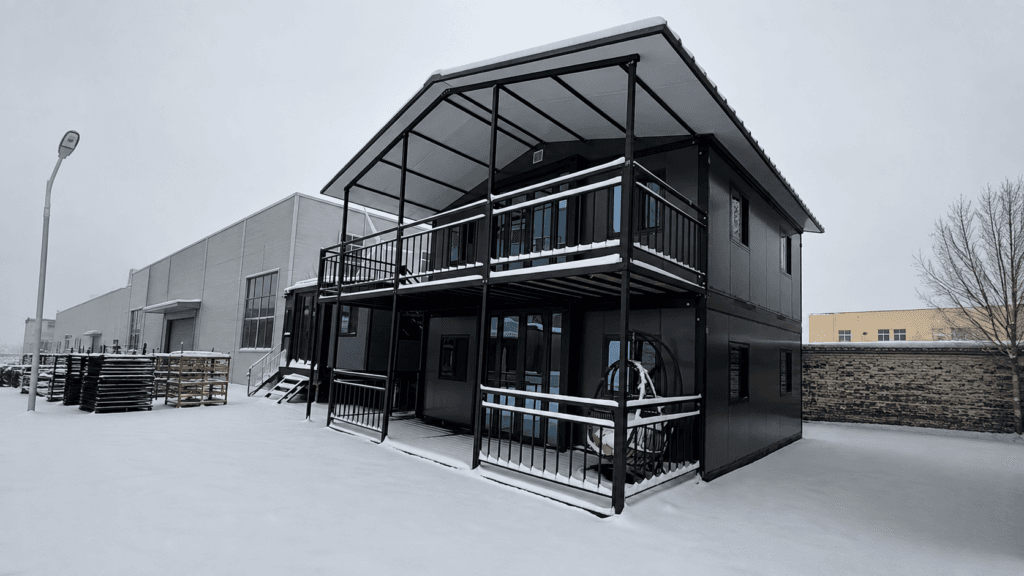
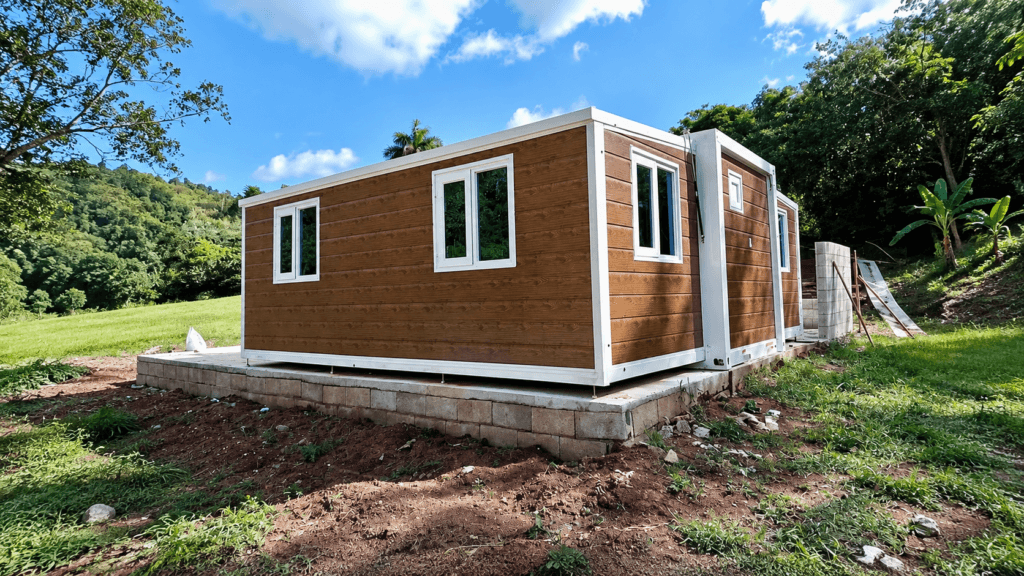
When buyers consider an expandable container house, one of the most common questions is:
How long does an expandable container house last?
A well-designed and properly maintained expandable container house can typically provide around 20–30 years or more of practical service life. In favorable environments, with good corrosion protection, waterproofing and regular maintenance, the usable lifespan can be even longer.
Whether an expandable container house is legally classified as a permanent building depends on local building codes, planning rules and approval requirements. However, legal classification and actual residential use are not the same thing.
From the perspective of daily living, a properly designed expandable container home can absolutely be used for long-term residential purposes.
What Determines the Lifespan of an Expandable Container House?
The lifespan of an expandable container house does not depend on one single component.
The most important factors include:
- Steel structure quality
- Galvanizing and corrosion protection
- Waterproofing
- Insulation
- Foundation
- Climate
- Wind and snow conditions
- Maintenance
A house installed in a dry inland climate will normally face very different conditions from one installed near the sea, in a snowy region or in a hurricane-prone area.
This is why the structural and insulation specifications should always be selected according to the destination.
Galvanized Steel Helps Extend Service Life
The structural frame is the core of an expandable container house.
High-quality models generally use galvanized steel or other anti-corrosion-treated steel components.
Galvanizing creates a protective zinc layer on the steel surface. This layer helps isolate the steel from moisture and oxygen, while also providing sacrificial protection.
In simple terms, the zinc layer corrodes before the steel underneath.
This significantly slows the rusting process and helps extend the expandable container house lifespan.
Galvanized steel is corrosion-resistant, but it is not completely maintenance-free. Damaged surfaces, welds, cut edges and scratched areas should be checked periodically.
If exposed steel is found, zinc-rich primer or anti-corrosion paint can be applied to restore protection.
Coastal Areas Need Stronger Corrosion Protection
Salt and humidity can accelerate corrosion.
For coastal areas, islands and seaside projects, expandable container houses can be upgraded with:
- Heavier galvanized coatings
- Hot-dip galvanized steel components
- Zinc-rich primer
- Additional anti-corrosion coatings
- Stainless-steel or corrosion-resistant fasteners
- Improved sealing
- Better drainage
These upgrades are especially useful for beach resorts, coastal rental projects and island accommodation.
Good drainage is equally important. The steel frame should not remain in contact with standing water for long periods.
Waterproofing Has a Major Impact on Lifespan
Water leakage is one of the most important issues affecting the service life of any prefabricated building.
Expandable container houses contain several connection areas, including:
- Roof joints
- Folding joints
- Wall connections
- Door frames
- Window frames
- Floor edges
Proper sealing and installation are essential.
For long-term use, sealants should be inspected periodically. If the sealant becomes cracked, aged or damaged, it should be replaced.
This type of maintenance is simple, but it can significantly improve the durability of the house.
Insulation Affects Long-Term Comfort
A house can be structurally durable but still uncomfortable if the insulation is poor.
For long-term residential use, the insulation system should match the local climate.
Common insulation materials include:
EPS is economical and widely used in warm and moderate climates.
Rock wool provides better fire resistance and sound insulation.
PU offers stronger thermal insulation and is particularly suitable for colder regions.
Insulation thickness can also be customized, commonly around:
- 50 mm
- 75 mm
- 100 mm
In cold climates, the roof and floor can also be insulated.
Good insulation reduces heat loss in winter and heat gain in summer, making the house more comfortable for year-round living.
Windows and Doors Also Matter
For long-term living, windows and doors should not be treated as minor components.
Customers can upgrade to:
- Double-glazed windows
- Thermal-break aluminum frames
- Low-E glass
- Insulated doors
- Improved sealing systems
These upgrades can improve both comfort and energy efficiency.
In colder regions, thermal-break windows and better glazing can make a noticeable difference.
A Proper Foundation Helps Protect the Structure
For long-term use, the house should be installed on a stable and level foundation.
Common options include:
- Reinforced concrete slab
- Concrete pads
- Strip foundation
- Screw piles
- Steel piles
A proper foundation helps reduce uneven settlement, structural movement and water accumulation.
It also helps keep doors and windows aligned over time.
In high-wind areas, the house should also be securely anchored to the foundation.
Can Expandable Container Houses Handle Strong Winds?
Yes, but the structural design should match the local wind conditions.
For higher-wind regions, the structure can be upgraded with:
- Thicker main beams
- Stronger columns
- Additional bracing
- Reinforced roof framing
- Stronger connection points
- Heavy-duty anchor bolts
- Stronger foundations
For hurricane- or typhoon-prone regions, the house may require a specially reinforced configuration.
This can include stronger steel framing, additional diagonal bracing, reinforced hinges, stronger exterior panels and improved anchoring.
The foundation and house should be designed as one complete structural system.
Can Expandable Container Houses Be Used in Snowy Regions?
Yes.
In regions with heavy snowfall, the roof structure can be strengthened according to the local snow load.
Possible upgrades include:
- Additional roof beams
- Thicker steel members
- Reduced spacing between supports
- Higher-strength steel
- Secondary pitched roof systems
A pitched roof can also help improve snow and rain drainage.
For cold climates, stronger roof insulation and floor insulation are normally recommended at the same time.
What About Very Hot Climates?
Expandable container houses can also be adapted for hot and tropical environments.
Typical upgrades include:
- Better roof insulation
- Reflective roof finishes
- Light-colored exterior panels
- Low-E glass
- Ventilation
- Air conditioning
- Exterior shading
The goal is to reduce solar heat gain and keep indoor temperatures more stable.
What About Earthquake-Prone Areas?
Steel structures have some natural advantages in seismic environments because they are lighter and more flexible than heavy masonry structures.
For earthquake-prone areas, performance can be improved through:
- Stronger structural connections
- Additional bracing
- Reinforced framing
- Proper anchoring
- Suitable foundation design
Where required, structural calculations should be based on local seismic standards.
How Much Maintenance Does an Expandable Container House Need?
Maintenance is generally straightforward.
Owners should periodically check:
- Roof waterproofing
- Exterior sealant
- Steel surfaces
- Welded joints
- Bolts and fasteners
- Window seals
- Door seals
- Drainage
- Bottom frame
Small problems should be repaired early.
For example:
A scratched protective coating can be repainted.
A cracked sealant joint can be resealed.
A loose fastener can be tightened.
Regular maintenance helps prevent minor issues from developing into larger problems.
Can an Expandable Container House Really Last 20–30 Years?
Yes, under suitable conditions.
A well-manufactured expandable container house can typically provide 20–30 years or more of practical service life.
However, this should not be treated as a fixed guarantee for every project.
Actual lifespan depends on:
- Material quality
- Corrosion protection
- Climate
- Installation
- Foundation
- Waterproofing
- Maintenance
A house in a mild inland climate with good maintenance may perform differently from one installed in a highly corrosive coastal environment.
The specification should therefore be customized according to the destination.
Can You Live in an Expandable Container House Long Term?
Yes.
A properly configured expandable container house can include:
- Bedrooms
- Living room
- Kitchen
- Bathroom
- Plumbing
- Electrical system
- Heating
- Air conditioning
- Insulation
- Finished interior surfaces
Larger models can provide enough space for couples and families, while smaller models are suitable for studios, guest houses, rental units and holiday accommodation.
For many buyers, the advantage is that the house can provide a complete living environment while requiring much less on-site construction than a traditional building.
Expandable Container House vs Traditional House
Traditional concrete and masonry houses are usually designed for a longer structural lifespan and are more familiar to local planning authorities.
Expandable container houses offer different advantages:
- Faster manufacturing
- Faster installation
- Lower on-site labor requirements
- Easier international transportation
- Flexible layouts
- Lower initial investment
- Possibility of relocation
For this reason, an expandable container house is not necessarily a replacement for every traditional building.
However, for residential, rental, hospitality and modular accommodation projects, it can be a practical long-term housing solution.
Final Answer: How Long Does an Expandable Container House Last?
A properly designed and maintained expandable container house can typically provide 20–30 years or more of service life.
Its lifespan depends mainly on the quality of the steel structure, corrosion protection, waterproofing, insulation, foundation and maintenance.
In coastal areas, cold climates, high-wind regions or snowy environments, the house can be reinforced and upgraded according to local conditions.
Whether it is officially classified as a permanent building depends on local regulations, but from the perspective of actual use, a well-built expandable container house can provide comfortable and reliable long-term living.